Commemorative Session: Markale Are Not Only a Site of Crime, but Also of Truth
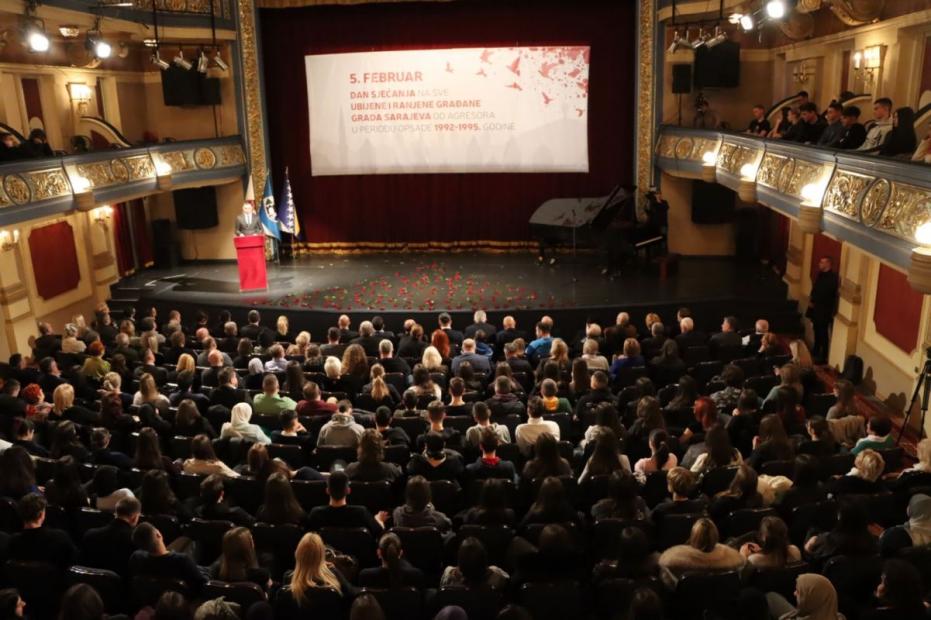


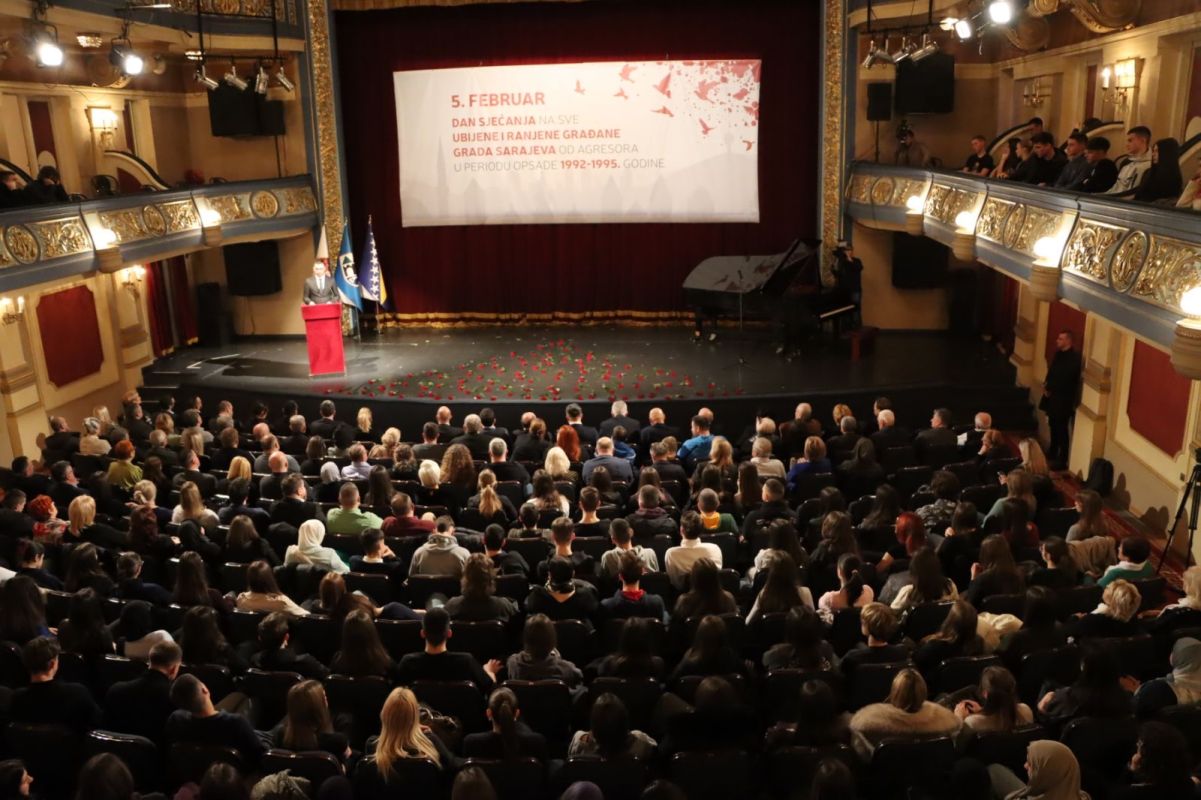
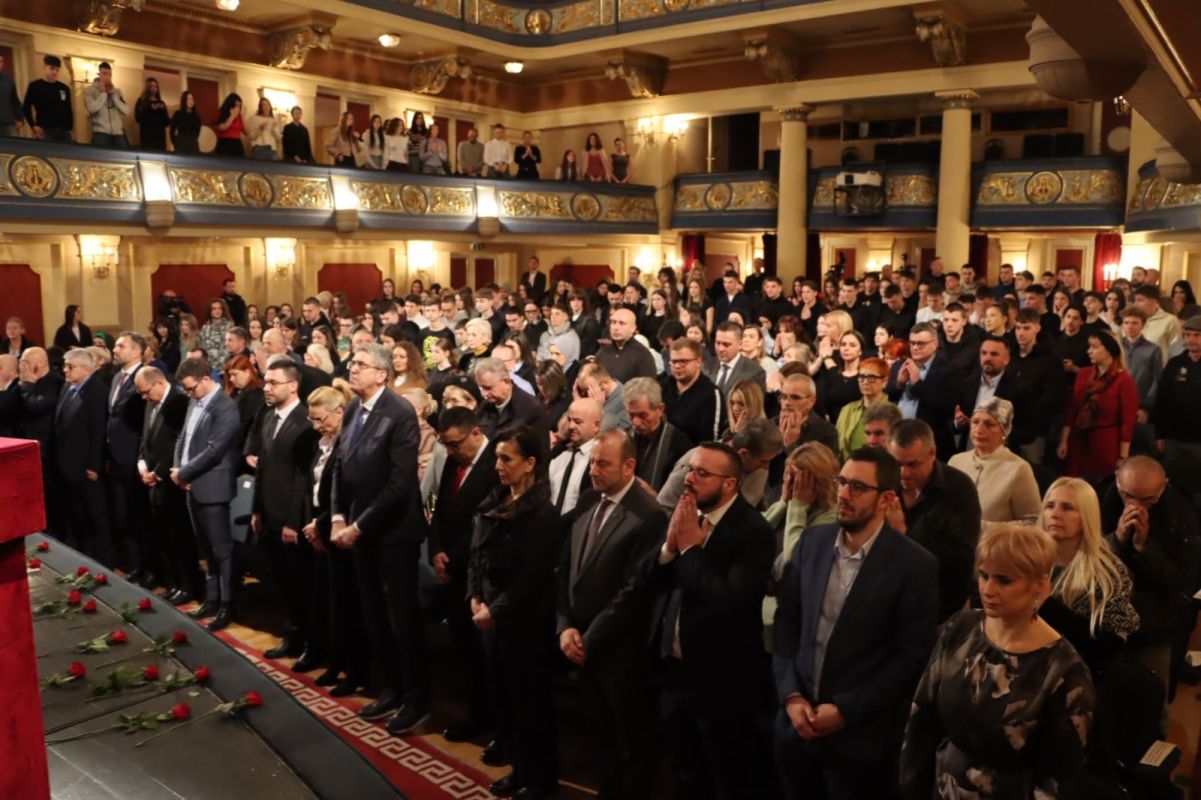
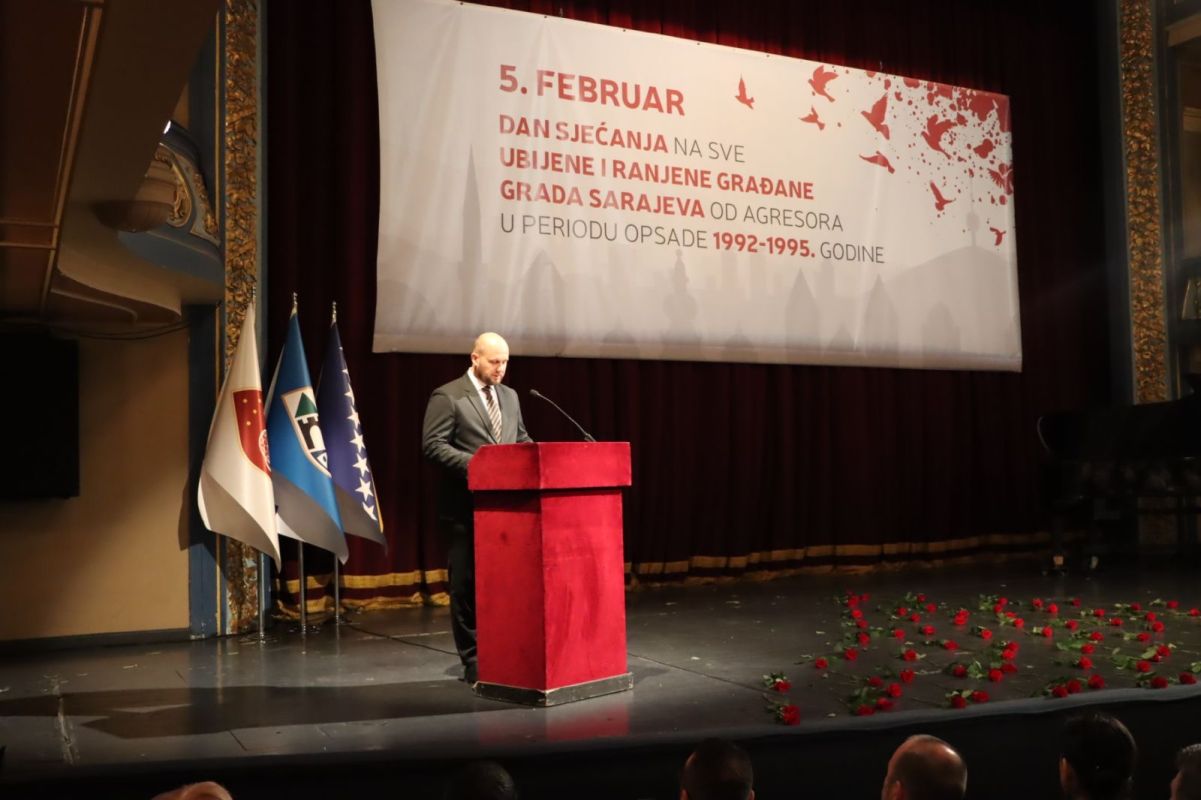
Forgetting must not cover innocent victims, as preserving the truth remains the foundation of lasting peace and the protection of future generations, it was stated today at a joint commemorative session of the Sarajevo Canton Assembly, the Sarajevo City Council, and municipal councils from across the Canton, held at the National Theatre Sarajevo on the occasion of the Day of Remembrance for citizens killed and wounded during the siege and the 32nd anniversary of the Markale massacre.
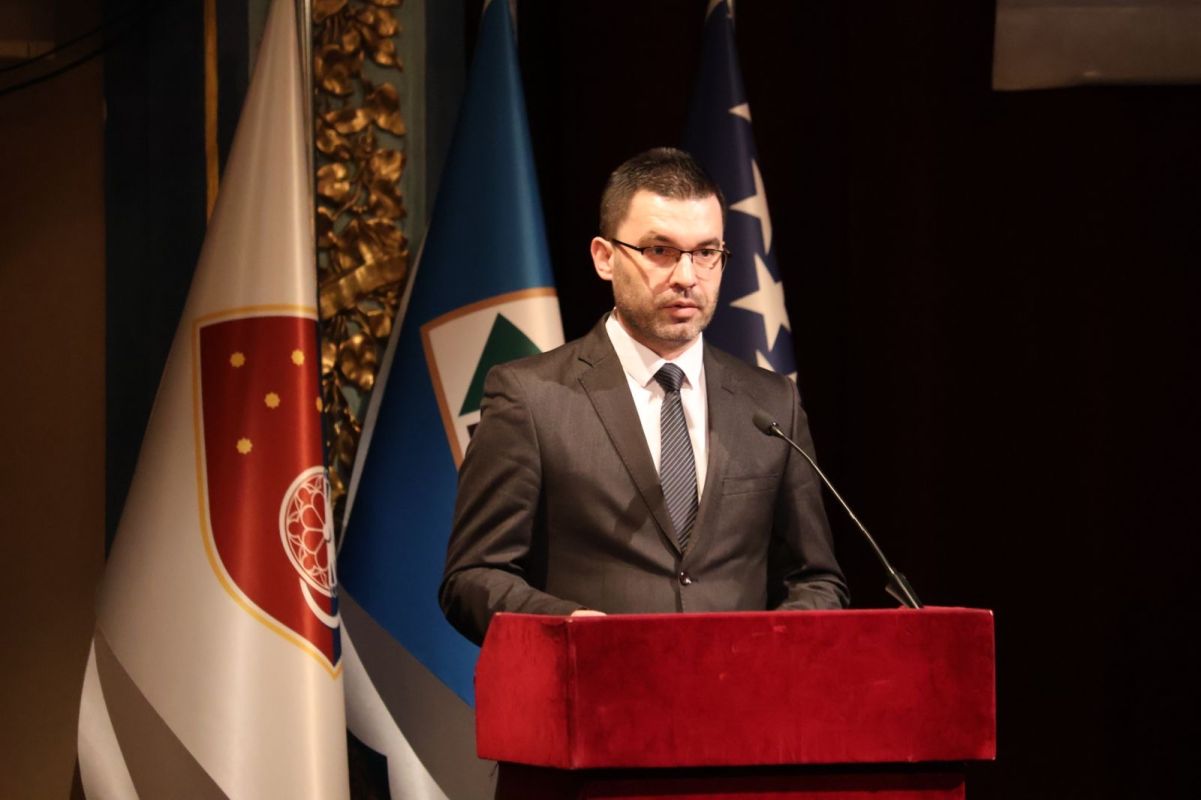
The Speaker of the Sarajevo Canton Assembly, Elvedin Okerić, recalled that in 2007 the Assembly proclaimed 5 February as the Day of Remembrance for all citizens of Sarajevo killed and wounded during the siege. He emphasized that the presence of students from the First Gymnasium, First Bosniak Gymnasium, and Obala Gymnasium was of particular importance, as young people are the ones who must preserve the truth about what happened so that such crimes are never repeated.
“Today, we nurture a culture of remembrance and do not allow forgetting to cover innocent victims and committed crimes. Sarajevo does not forget its citizens who gave their lives for freedom. Thirty-two years ago, in 1994, one of the gravest crimes of the siege of Sarajevo was committed at the Markale marketplace. Sixty-eight of our fellow citizens were killed and 142 wounded. The Markale massacre has remained a permanent symbol of Sarajevo’s suffering during the 1,425 days of the siege, in which more than 11,500 citizens were killed, including 1,601 children, while more than 50,000 people were wounded,” said Okerić.
The search for justice continues
He added that behind every number there is a human story cut short, pain, and an irreparable loss for families and society.
“Although more than three decades have passed since the aggression against Bosnia and Herzegovina, the search for full justice is still ongoing. Insisting on the prosecution of all those responsible for war crimes is not only a moral and civilizational obligation, but also a fundamental guarantee of lasting peace,” Okerić emphasized.
He warned that ideologies of evil, if left unchallenged, become an alibi for new crimes.
“Today we are witnessing horrific destruction in Gaza, where aggression and terror are being carried out against the population. It is our duty to preserve, transmit, and defend the truth on behalf of the victims, future generations, and peace. Forgetting must not cover innocent victims,” the Speaker of the Sarajevo Canton Assembly stated.
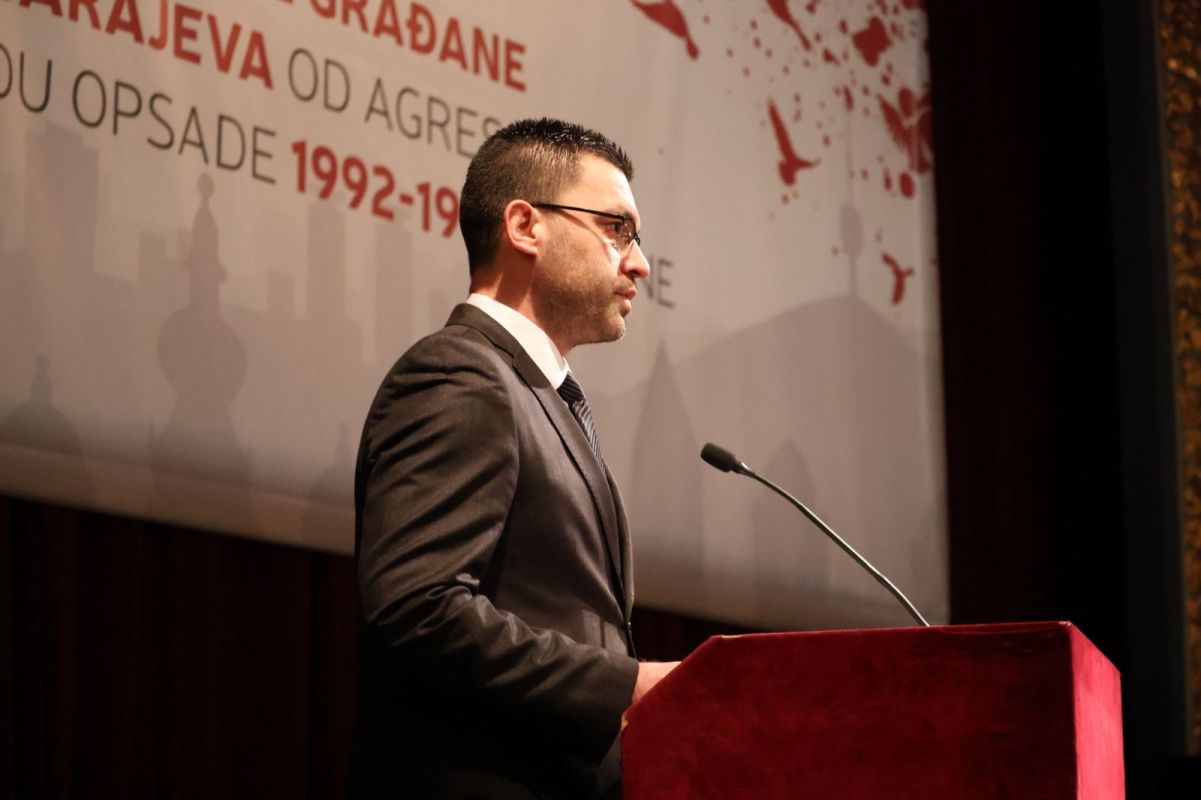
The Director of the Institute for Research of Crimes Against Humanity at the University of Sarajevo, Muamer Džananović, recalled that the Markale massacre is one of the most thoroughly documented crimes against civilians during the siege of Sarajevo.
“For me, this day is especially emotional, as it is for everyone who survived the siege of this city. At the beginning of 1992, I was not yet seven years old and spent the aggression in Sarajevo. I do not say this to personalize facts, but to remind us that behind statistics there are childhoods, families, streets, neighborhoods, memories, trauma, and pain,” said Džananović.
He recalled the crime in the Otoka neighborhood on 10 November 1993, when nine citizens were killed, including five children—the youngest two years old and the oldest nine.
“For that crime, as well as for many other mass crimes committed during the siege, no one has been held accountable before Bosnia and Herzegovina’s judiciary to this day,” he stated.
Džananović described everyday life during the siege, recalling the explosion of a modified aerial bomb on 28 June 1995 near the RTV building.
“That was my everyday reality, as well as the reality of Sarajevans of all ages, many of whom did not survive. Those of us who were children at the time did not fully understand what was happening. In basements and shelters where we spent days and nights, there was sometimes an illusion of normality. We played, talked, and tried to preserve fragments of childhood. What we were not aware of then was that our childhood had been violently interrupted and that fear, loss, and insecurity became the foundation of our growing up,” he said.
A systemic pattern of terror against civilians
He stressed that contemporary trauma research shows that wartime violence does not end with the end of war, and that trauma functions as a permanent psychological imprint. He referred to American theorist Marianne Hirsch, who speaks of postmemory—the experience of generations who carry the consequences of events they experienced as children or inherited through family and social memory.
“Judgments of the Hague Tribunal contain clear evidence that the 7th Battalion of the 1st Romanija Infantry Brigade of the Sarajevo-Romanija Corps possessed a 120 mm mortar in Mrkovići, northeast of Markale. For the sake of the victims, it is important to emphasize that denial is not an alternative opinion. Markale was not an isolated case, but part of a systemic pattern of terror against Sarajevo’s civilian population and mass crimes,” Džananović emphasized.
He recalled that the neighborhoods of Alipašino Polje, Dobrinja, Čengić Vila, Hrasno, Marijin Dvor, Sedrenik, Soukbunar, and other locations were shelled, and that between the first and second Markale massacres the area was shelled repeatedly, as were frequented parts of Sarajevo’s city center.
“The residents of Sarajevo, like the residents of other so-called United Nations safe areas, in reality had no protection whatsoever. After Srebrenica was declared a safe area on 16 April 1993, followed by Žepa, Goražde, Sarajevo, Tuzla, and Bihać on 6 May, the largest military operations of the self-proclaimed Army of Republika Srpska and the Yugoslav Army were carried out precisely under that status, along with the most massive crimes against civilians, including Markale on 5 February 1994 and 28 August 1995,” Džananović concluded.
As part of the commemorative session, the exhibition of the Institute for Research of Crimes Against Humanity and International Law of the University of Sarajevo, “Crimes at Markale: Killing and Wounding of Civilians – Prosecution of Perpetrators, Denial of Truth, Resistance to Forgetting,” was opened at the National Theatre.
The authors of the exhibition are Muamer Džananović, Director of the Institute; Merisa Karović-Babić, Senior Research Associate; and Sead Muhić, Operational Associate of the Institute.
The exhibition provides a comprehensive overview of the siege of Sarajevo (1992–1996) and documents in detail the two Markale massacres—on 5 February 1994, when 68 civilians were killed, and on 28 August 1995, when 43 civilians were killed. The exhibition includes expert reports, UNPROFOR documents, judgments of the International Criminal Tribunal for the former Yugoslavia (ICTY), media reports, photographs and video materials, as well as archival materials and the Institute’s publishing activity.
A particularly significant segment of the exhibition consists of photographs of all victims killed in both massacres and a list of the wounded, alongside an examination of responsibility for the crimes at Markale. The exhibition also points to the devastating fact that, before the Court of Bosnia and Herzegovina, no one has yet been held accountable for these crimes, nor for many other crimes committed in Sarajevo during the siege. The NATO intervention “Deliberate Force,” carried out two days after the 1995 massacre, is also addressed, as well as the issue of institutional revisionism of these crimes, present from the time of their commission to the present day.
Following its opening at the National Theatre, the exhibition will be open to visitors at the Bosnian Cultural Centre starting on 6 February.
Names of those killed
On 5 February, 32 years ago, the following were killed at the Markale marketplace: Senad Arnautović, Ibrahim Babić, Mehmed Baručija, Ćamil Begić, Emir Begović, Vahida Bešić, Gordana Bogdanović, Vaskrsije Bojinović, Muhamed Borovina, Faruk Brkanić, Sakib Bulbul, Jelena Čavriz, Almasa Čehajić, Verica Čilimdžić, Alija Čukojević, Zlatko Ćosić, Smilja Delić, Ifet Drugovac, Dževad Durmo, Fatima Durmo, Kemal Džebo, Ismet Fazlić, Vejsil Ferhatbegović, Dževdet Fetahović, Muhamed Fetahović, Ahmed Fočo, Majda Ganović, Isma Gibović, Rasema Hasanović, Alija Hurko, Mirsada Ibrulj, Mustafa Imanić, Rasema Jažić, Razija Junuzović, Hasija Karavdić, Mladen Klačar, Marija Knežević, Selima Kovač, Ibro Krajčin, Sejda Kunić, Jozo Kvesić, Numo Lakača, Ruža Malović, Jadranka Minić, Safer Musić, Nura Odžak, Mejra Orman, Hajrija Oručević, Seid Prozorac, Smajo Rahić, Igor Rehar, Sabit Rizvo, Zahida Sablja, Nedžad Salihović, Hajrija Smajić, Emina Srnja, Džemo Subašić, Šaćir Suljević, Hasib Šabanović, Ahmed Šehbajraktarević, Bejto Škrijelj, Junuz Švrakić, Pašaga Tihić, Munib Torlaković, Ruždija Trbić, Džemil Zečić, Muhamed Zubović and Senad Žunić.
The Serbian siege of Sarajevo began on 5 April 1992 and ended on 29 February 1996. It is estimated that around 500,000 shells were fired at the city during the siege. For war terror against the citizens of Sarajevo, including the two Markale massacres, the former President of Republika Srpska, Radovan Karadžić, was sentenced to life imprisonment in March 2019, as was Ratko Mladić, Commander of the Main Staff of the Army of Republika Srpska (VRS).
For war crimes against the population of Sarajevo, the International Court in The Hague sentenced high-ranking VRS officers—Stanislav Galić to life imprisonment and Dragomir Milošević to 29 years in prison.