Collection of Papers Published: “Srebrenica 30 Years After the Genocide: Memory, Responsibility, and the Challenges of Denial”
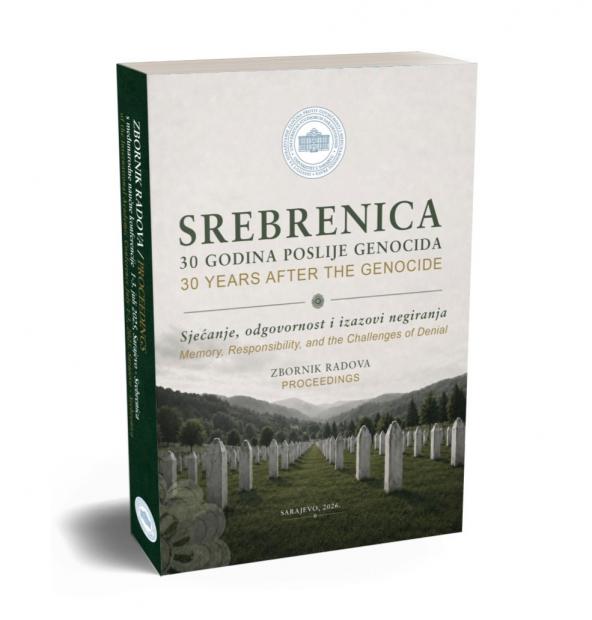


The University of Sarajevo – Institute for Research of Crimes Against Humanity and International Law has published a collection of papers titled “Srebrenica 30 Years After the Genocide: Memory, Responsibility, and the Challenges of Denial.”
The collection is the result of an international academic conference held from July 1 to 3, 2025, in Sarajevo and Srebrenica, organized by the University of Sarajevo to mark the thirtieth anniversary of the genocide against Bosniaks in and around Srebrenica.
The publication brings together domestic and international authors from the fields of history, law, sociology, political science, anthropology, genocide studies, and memory studies. Their papers present diverse research and analytical approaches to the genocide in Bosnia and Herzegovina, with a particular focus on the Srebrenica genocide—its causes and consequences, judicially established facts and verdicts, contemporary forms of denial, politics of memory, survivors' experiences, and genocide education.
In a joint foreword, University of Sarajevo, Prof. Dr. Tarik Zaimović, and the Director of the Institute, Dr. Muamer Džananović, emphasize that Srebrenica is not merely a subject of historical research but also a site of contemporary responsibility, as well as a Bosnian-Herzegovinian, European, and global issue regarding the approach to genocide, justice, truth, and human dignity. They particularly warn that, despite final judgments by international and domestic courts, forensic evidence, mass graves, and survivor testimonies, attempts are still being made to dispute, relativize, and politically instrumentalize the Srebrenica genocide.
The volume’s editor, Dr. Zilha Mastalić Košuta, emphasizes that the collection is not merely a compilation of original scholarly research. It brings together scholarly and professional papers, essays, analytical reviews, and testimonies, linking research into the past with contemporary issues of accountability, memorialization, education, and countering genocide denial.
The volume contains 16 papers organized into four thematic sections.
The first section, "Conceptual, Historical, and Historiographical Foundations of the Genocide in Bosnia and Herzegovina," features papers by Ben Kiernan, Marko Attila Hoare, Norman M. Naimark, and Zilha Mastalić Košuta. The authors analyze the historical and ideological context of the genocide in Bosnia and Herzegovina, the Srebrenica genocide as the culmination of a broader genocidal policy, shifts in historiographical interpretations, and the political, military, humanitarian, and institutional mechanisms that preceded the Srebrenica genocide.
The second section, "Law, Evidence, and the Shaping of Judicial Truth," includes papers by Muamer Džananović, Jasmin Medić, Mujo Begić, Rosa Aloisi, and Jayden Salter. This section examines the Cultural Center in Pilica as a site of civilian detention and killing in 1992 and 1995; the significance of guilty pleas before the International Criminal Tribunal for the former Yugoslavia; the concealment of crimes through the relocation of mass graves in Srebrenica and Prijedor; and the relationship between memorialization, judicially established facts, and resistance to accepting them.
The third part, "Denial, Politics of Memory, and International Responses," presents works by Edina Bećirević, Hikmet Karčić, Ben Gerstein, and Benjamin Valentin. The authors analyze the link between genocide denial and contemporary security and geopolitical processes; the relationship between institutionalized memory and institutionalized denial; the political implications of United Nations General Assembly Resolution A/RES/78/282; and the international lessons—both learned and unlearned—regarding the Srebrenica genocide.
The fourth part, "Memory, Testimony, and Cultural Representations," brings together works by Hariz Halilovich, Sarina Bakić, Hasan Nuhanović, Kim Sadique, and Rafiki Ubaldo. These works address the ethics of testimony, the role of culture in preserving collective memory, the experience of space and the journey to Srebrenica, genocide education as a means of preventing future crimes, and the possibilities for societal recovery following genocide. According to the editor, the volume’s particular value lies in bridging domestic and international research perspectives and fostering a dialogue among historiographical, legal, sociological, and memory-focused approaches to the study of the genocide in Bosnia and Herzegovina. The papers are published in either Bosnian or English, with all abstracts translated to ensure the publication is accessible to both domestic and international audiences.
The volume is intended for scholars, researchers, educators, students, institutions, and civil society organizations, as well as the general public interested in understanding the genocide in Bosnia and Herzegovina, its long-term consequences, the culture of remembrance, and the contemporary challenges posed by genocide denial.
The volume Srebrenica 30 Years After the Genocide: Remembrance, Responsibility, and the Challenges of Denial is indexed in the Central and Eastern European Online Library (CEEOL), and its electronic edition (PDF format) is available for free download on the Institute’s website.