The 10th Economy Forum of Bosnia and Herzegovina Held


Synergy of Knowledge and Technology as Key to a Sustainable Future
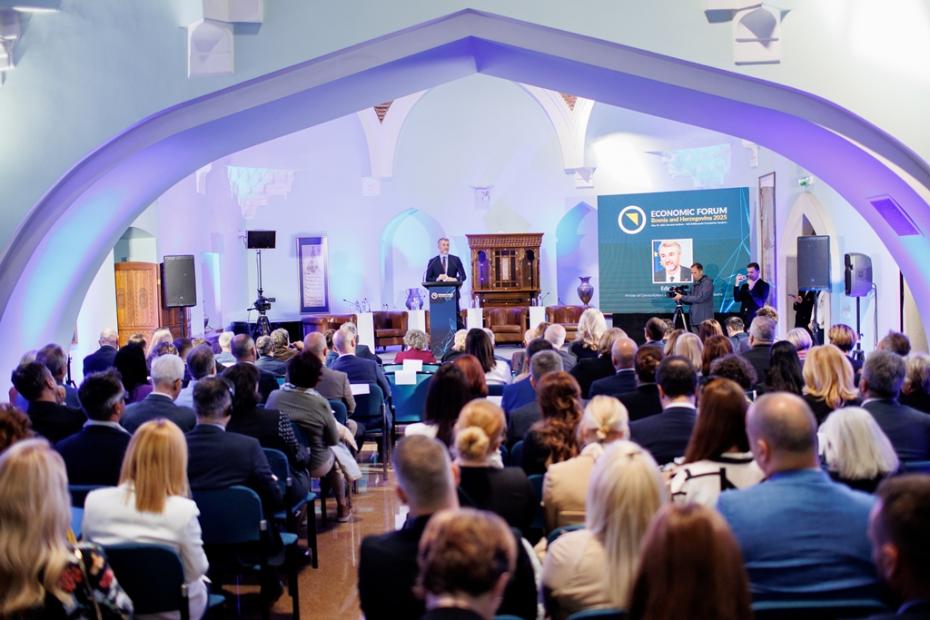
Sarajevo, 19/05/2025 — Today, the Economy Forum of Bosnia and Herzegovina 2025 took place in Sarajevo, organized by the University of Sarajevo — Faculty of Economics. The theme of the Forum, “Sustainable Development and Digital Transformation,” was presented through two panels and a practical workshop. The speakers included prominent experts and professionals from the public and private sectors, as well as representatives of Bosnian authorities. The event was officially opened by the Dean of the Faculty of Economics, Prof. Dr. Meliha Bašić, who stated: “I am convinced that the synergy of all sectors — government, industry, academia, and civil society — combined with engaging all our citizens, is key to achieving sustainable growth goals and implementing digitalization across all segments. We need to understand that digital transformation is not just a technological process. It is a catalyst for change in how we work, communicate, manage, and do business. And we have the resources — primarily knowledge and digital tools — which is also the central message of this year’s Forum.”
The keynote speakers of the 2025 Forum included: Edin Forto, Minister of Transport and Communications of Bosnia and Herzegovina; Jasmina Selimović, Governor of the Central Bank of Bosnia and Herzegovina; and Zlatko Lagumdžija, Permanent Representative of Bosnia and Herzegovina to the United Nations (UN). Minister Forto emphasized that digital transformation is no longer an abstract concept but an unstoppable process shaping modern society. “With the introduction of digital services, entire chains of technological development are launched. Once digitalization begins, it becomes a driver of change,” said Minister Forto. Governor Selimović highlighted that this topic has long sparked debates among academic and business circles about how best to leverage technology for economic, social, and intellectual progress. She pointed out that it is no coincidence that digitalization first found its place in the financial sector, which, besides being one of the most competitive sectors, also had the resources for investment and digitalization, thus laying the foundation for the development of numerous other sectors — from online commerce to digital services. Digital transformation entails doing things differently and changing the business model. “Only then will the benefits of digital transformation become evident, allowing us to save resources — financial, human, and otherwise. In fact, I would say this is the only true path,” concluded Governor Selimović.
Prof. Dr. Zlatko Lagumdžija, Bosnia and Herzegovina’s Permanent Representative to the UN and one of the Forum’s keynote speakers, delivered an inspiring lecture on the interconnectedness of sustainable development, digital transformation, and European integration, emphasizing the need for a “logic of tomorrow” — because yesterday’s solutions do not address today’s challenges. His presentation focused on the Growth Plan — a strategic framework that unites approaches to the EU single market, strengthens the regional common market, implements fundamental reforms, and secures increased financial resources. As highlighted, this plan is a key to realizing the goals of Agenda 2030, the Future Pact, COP 29, and other global initiatives. Dr. Lagumdžija also discussed the four simultaneous revolutions shaping the world by 2030: digital, sustainable, geopolitical, and human — calling for progressive partnerships among people, the planet, prosperity, and purpose. He particularly emphasized new global industries that will dominate the world economy in the coming decades, as well as future skills critical for competitiveness, including artificial intelligence, technology, creativity, resilience, and social impact. “If we want to build a sustainable, digitally empowered, and competitive Bosnia and Herzegovina, we must act now — with a vision for the future and strength in cooperation,” concluded Dr. Lagumdžija.
The first panel, titled “Sustainable Development Goals (SDGs) and Digital Transformation,” was moderated by Almir Badnjević, Director of the Agency for Identification Documents, Records, and Data Exchange of Bosnia and Herzegovina (IDDEEA). Panelists included: Davor Bunoza, Minister of Justice of Bosnia and Herzegovina; Vedran Lakić, Minister of Energy, Mining, and Industry of the Federation of Bosnia and Herzegovina; Renaud Meyer, UNDP Resident Representative in Bosnia and Herzegovina; and Jasmin Mahmuzić, Director of the Banking Agency of the Federation of Bosnia and Herzegovina. “Today, it is clear that digital transformation is not an isolated process. It requires a shared vision, cross-sector cooperation, and commitment from all levels of government and society. Technology is a tool — but how we use it, and how we put it in service of people and sustainable development, is up to us,” concluded moderator Badnjević.
The impact of digital transformation on industries was the theme of the second panel, whose participants included: Svjetlana Perković, Director of IT Sector at the Indirect Taxation Authority of Bosnia and Herzegovina; Seid Fijuljanin, Director of LANACO Sarajevo; Michele Castoro, CEO of Intesa Sanpaolo Bank Bosnia and Herzegovina; and Faruk Jažić, Sales Director for SaaS, corporate, and public sectors in Southeast Europe at Oracle. The session was moderated by Prof. Dr. Kemal Kačapor, President of the Association for Digital Transformation in Bosnia and Herzegovina. One of the key conclusions was that investing in IT and digital skills, both in formal and informal education, is crucial for the development of digital processes and the progress of Bosnia and Herzegovina.
An integral part of the 10th Bosnia and Herzegovina Economic Forum was a workshop titled “Digital Transformation in Practice: Qualified Electronic Signature and Data Exchange,” organized by the Agency for Identification Documents, Records, and Data Exchange of Bosnia and Herzegovina (IDDEEA). Special focus was given to the Qualified Electronic Signature (QES), which has the same legal validity as a handwritten signature. QES enables citizens and institutions to quickly, securely, and legally sign documents digitally. Examples of cooperation with international systems such as Interpol and the EU Tahonet network, as well as real-time data exchange between domestic institutions, were presented. It was concluded that digital signatures and improved inter-institutional connectivity contribute to faster services, less paperwork, greater security, and more efficient public administration.
The Bosnia and Herzegovina Economy Forum 2025 was organized in partnership with distinguished international, regional, and local partners, including the United Nations Development Programme (UNDP), the Agency for Identification Documents, Records, and Data Exchange of Bosnia and Herzegovina (IDDEEA), IT company LANACO, the Foundation for Building a Shared Society and Values, the SDG Solutions Network for the Western Balkans (SDSN WB), the Nizami Ganjavi International Center (NGIC), and the Bosniak Institute — Adil Zulfikarpašić Foundation.