Faculty of Criminalistics, Criminology and Security Studies Participates in Implementation and Final Analysis of National Cybersecurity Tabletop Exercise in Neum



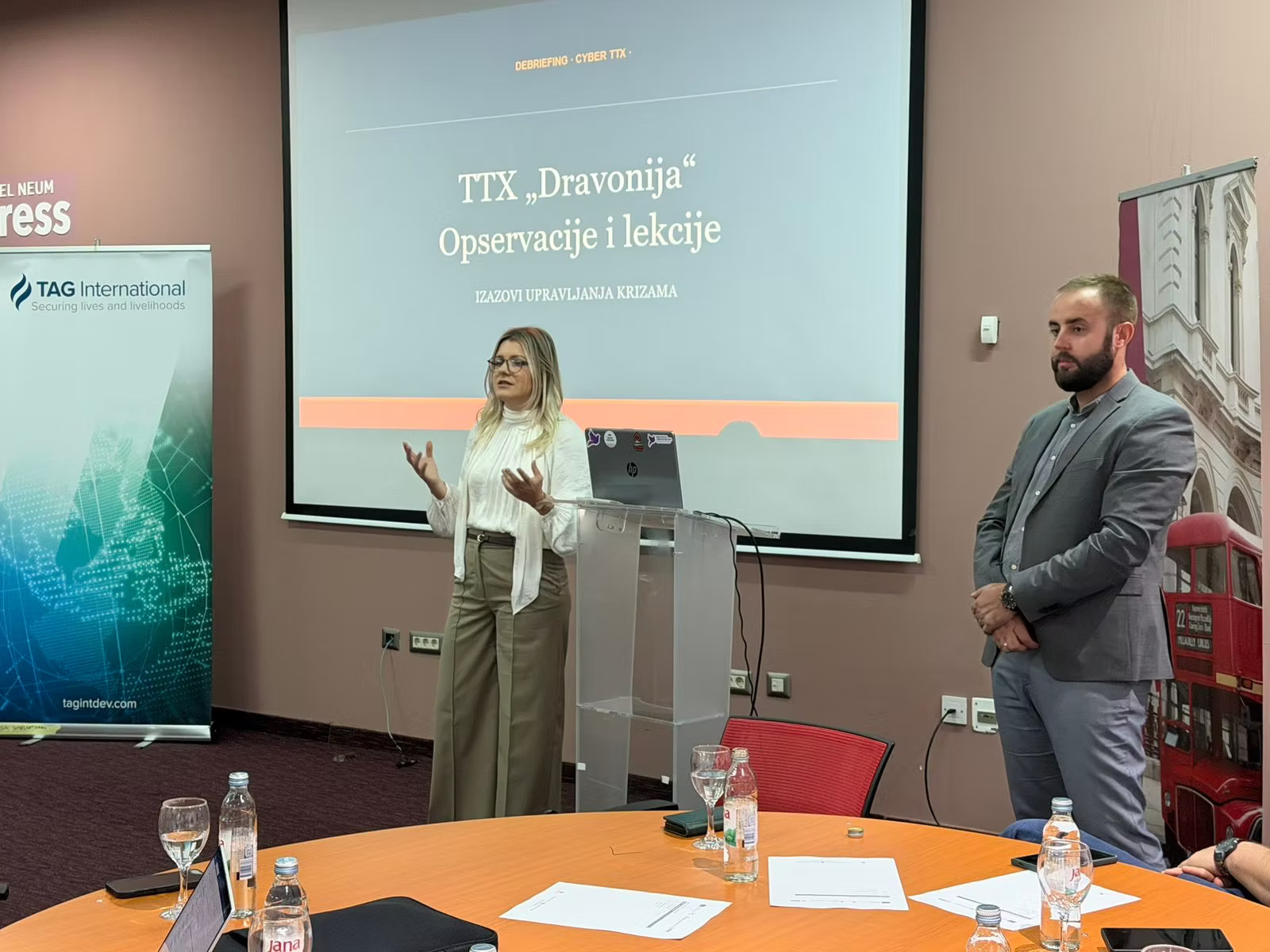
On 28 and 29 October 2026, a two-day national tabletop exercise (Cybersecurity Tabletop Exercise – TTX) was held in Neum, bringing together representatives of relevant institutions of Bosnia and Herzegovina with the aim of testing interinstitutional coordination, information exchange, and decision-making under the conditions of a complex cyber incident. The University of Sarajevo – Faculty of Criminalistics, Criminology and Security Studies was represented by Asst. Prof. Dr. Nerma Halilović-Kibrić, and Asst. Prof. Dr. Kenan Hodžić who contributed to the implementation of the exercise through their expert and academic engagement, and particularly to its final analysis, assessment, and formulation of key findings and recommendations. The exercise was based on a realistic, nationally anonymized scenario that simulated the development of several interconnected cyber and security challenges. Through a series of situational tasks and information gradually made available to participants, the ways in which institutions identify threats, exchange information, align their actions, and make decisions when time and available information are limited were tested. The particular significance of the exercise lay in the possibility of considering a broader institutional response, beyond the competences and capacities of individual organizations. The focus was not only on whether a single institution can respond to an individual incident, but also on whether the system can function as a whole when several incidents develop simultaneously and when the actions of one actor directly affect the ability of others to act. In the final part of the exercise, Asst. Prof. Dr. Nerma Halilović-Kibrić and Asst. Prof. Dr. Kenan Hodžić conducted a structured analysis and assessment of the scenarios implemented, the participants' actions, and the dynamics of the interinstitutional response. The analysis covered six key dimensions:
- information flow and the early warning system;
- shared situational understanding and recognition of broader threat patterns;
- interinstitutional coordination and information exchange;
- information management and public communication;
- decision-making under pressure, with incomplete and sometimes contradictory information;
- the system's ability to function in a coordinated manner during the simultaneous development of multiple incidents.
The final assessment made it possible to identify concrete challenges, but also to define the areas where institutional procedures, communication channels, clarity of responsibilities, coordination mechanisms, and joint action need further improvement. The particular value of this approach is that experiences from the simulation are translated into practical recommendations that can serve as a basis for future strengthening of institutional preparedness and resilience. The participation of the Faculty's teaching staff in this activity represents a contribution to connecting academic knowledge, research work, and the practical needs of institutions in the field of cybersecurity. At the same time, it confirms the importance of the academic community in developing professional capacities, understanding contemporary security threats, and improving the response to complex security challenges. The tabletop exercise was organized by TAG International and the e-Governance Academy (eGA), in partnership with the Ministry of Security of Bosnia and Herzegovina and the Ministry of Communications and Transport of Bosnia and Herzegovina, within the program Enhancing Cyber Security and Institutional Resilience in Bosnia and Herzegovina and EU Cyber Balkans II, with the support of the Government of the United Kingdom and the European Union.