Roundtable Held to Mark the 900th Anniversary of Ibn Rushd’s Birth
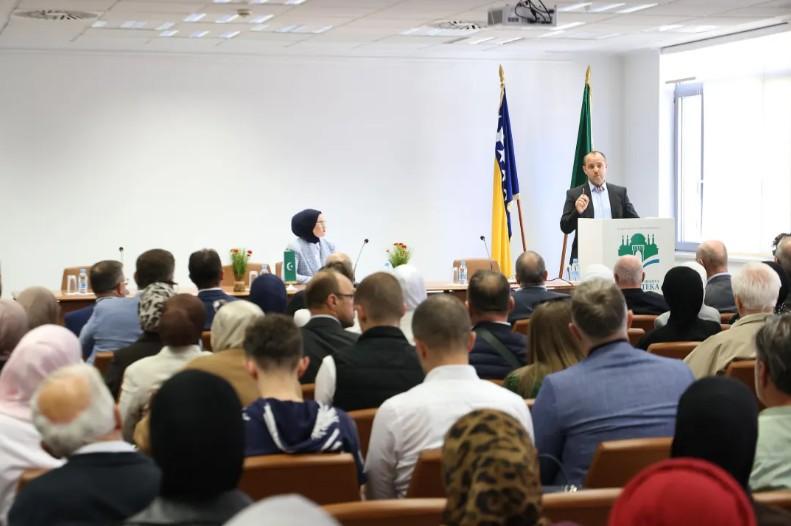


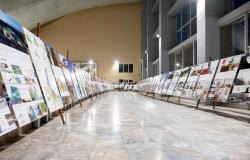
A roundtable was held today in Sarajevo, in the Central Hall of the Gazi Husrev-beg Library, to mark the 900th anniversary of the birth of Ibn Rushd, one of the most significant Muslim philosophers and thinkers.
The event was organized by the Department of Islamic Philosophy at the University of Sarajevo’s Faculty of Islamic Studies, the Office for Education and Science of the Rijaset of the Islamic Community in Bosnia and Herzegovina, and the Gazi Husrev-beg Library.
The aim of the event was to present various aspects of Ibn Rushd’s life, works, and intellectual legacy, his contribution to the development of Islamic philosophy, and the influence of his thought on the Western philosophical tradition.
Particular attention was devoted to the significance of Ibn Rushd’s ideas and their relevance in the modern era.
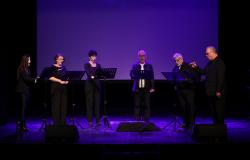
During the roundtable, presentations were delivered by Professor Dr. Samedin Kadić, who spoke on the topic “The Al-Muwahhidun Project of ‘Abandoning Taqlid and Returning to the Sources,’” and Professor Emeritus Dr. Enes Karić, who presented on Ibn Rushd’s teaching on the creation of the world.
Professor Dr. Enes Karić expressed his satisfaction that the Department of Islamic Philosophy at the Faculty of Islamic Studies had organized a discussion dedicated to Ibn Rushd, emphasizing his importance in connecting different philosophical and cultural worlds.
“Ibn Rushd is one of those philosophers who connected worlds. As a great scholar of the Greek language, he translated and commented on Aristotle’s works, translating the idiom of the Greek language into the Arabic language of philosophy and science. All of this took place in the Middle Ages,” said Professor Karić.

According to him, Ibn Rushd’s significance is reflected precisely in his outstanding and mediating role in the transmission of philosophical ideas.
“He is important precisely because of that superbly executed, well-defined, mediating role in transmitting Islamic and Greek philosophy—that is, the Eastern philosophies—to the medieval West. That is Ibn Rushd,” said Karić.
He recalled that this year marks 900 years since Ibn Rushd’s birth. Ibn Rushd was born in 1126 and died in 1198.
“This anniversary is a great one. Such a man, with such a mind, such a spirit, and such reason, deserves to be discussed,” concluded Professor Karić.
Professor Samedin Kadić emphasized that it is important to discuss this topic today as well, particularly in light of the importance of interpreting texts and understanding different cultures.
“Ibn Rushd was, above all, a great commentator and a man who demonstrated the art of interpreting another culture. Through his monumental commentaries on Aristotle, he also demonstrated the greatness of Islam itself—that is, the capacity of Islam as a religion and culture to absorb other worlds and cultures that are, by definition, difficult to decode, without changing its own system,” said Kadić.
According to him, the significance of Ibn Rushd’s work is particularly reflected in the fact that, after centuries of Islamic philosophy, he was able to reread Aristotle and free his teaching from Neoplatonic influences.
“This, in a way, shows that it is possible to unlock texts, but also that misreadings can persist for centuries and be accepted as absolute truths. Through quality interpretation, it is possible to show that such readings are not necessarily true, but rather that something else is meant,” said Professor Kadić.

He concluded that this is precisely why there is still a need for continuous reading and interpretation of texts, in the search for new and more accurate understandings of their meaning.
Other participants of the event also spoke about the significance of Ibn Rushd’s thought, his philosophical, legal, and theological legacy, and the various possibilities for contemporary readings of his works.
During the roundtable, presentations were delivered by Professor Dr. Samedin Kadić on the topic “The Al-Muwahhidun Project of ‘Abandoning Taqlid and Returning to the Sources’”; Professor Emeritus Dr. Enes Karić on “Ibn Rushd’s Teaching on the Creation of the World”; Professor Dr. Senad Ćeman on “Ibn Rushd as a Jurist: Bidāyat al-Mujtahid Between the Fiqh of Divergence and the Methodology of Ijtihad”; Professor Dr. Rusmir Šadić on “The Epistemological Potential of Ibn Rushd’s Thought”; Dr. Vladimir Lasica on “Ibn Rushd’s Metaphysics and Its Place in the History of Philosophy”; Mr. Haris Dubravac on “Ibn Rushd’s Approach to the Qur’an”; Mr. Umihana Šošić on “The Social Role of Women in Ibn Rushd’s Reading of Plato’s Republic”; and Mr. Riad Subašić on “Ibn Rushd’s Concept of Ta’wil: Possibilities and Limits of Interpretation.”
The roundtable provided an opportunity for interdisciplinary reflection on Ibn Rushd’s rich intellectual legacy and his place in the history of Islamic and world philosophical thought, as well as for discussing the possibilities of his reception in the contemporary academic space.