Faculty of Islamic Studies, University of Sarajevo Marks Its 49th Anniversary: Preparations for Half a Century of Work Have Already Begun
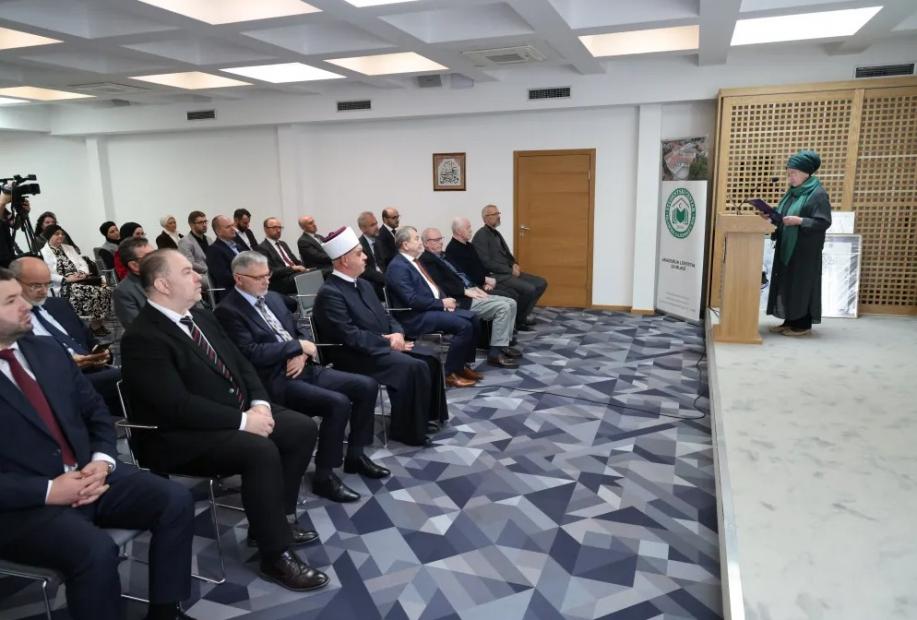


The 49th anniversary of the Faculty of Islamic Studies at the University of Sarajevo was marked today in Sarajevo with the presentation of scientific research projects and award ceremonies.
The anniversary program was held at the Student Center of the Islamic Community in Bosnia and Herzegovina and brought together representatives of the Faculty, the Islamic Community, the academic community, faculty members, associates, and other guests.
The Grand Mufti of the Islamic Community in Bosnia and Herzegovina, Husein Kavazović, addressed those present, emphasizing that the Faculty of Islamic Studies represents one of the key points in the spiritual and intellectual development of the Islamic Community, and that its mission rests on cultivating Islamic scholarship and responding to the challenges of the modern era.
He recalled the vision of the Faculty’s founders, who wanted to establish an institution that would connect classical Islamic scholarship with modern scientific methodologies. Kavazović emphasized that the Faculty today represents an important center for the development of Islamic thought in the Balkans and a platform for authentic academic dialogue in a European and pluralistic environment.
“This is precisely where our new perspective lies. Since its founding, the Faculty of Islamic Studies has offered a platform for authentic academic dialogue, in which Islamic theology is positioned as an equal and constructive interlocutor with other religious and secular traditions,” said Kavazović.
He particularly highlighted the challenge of Islamophobia, emphasizing that the response to prejudice and stereotypes should be educational, scientifically grounded, and based on open dialogue.
“Our response to these phenomena should, above all, be educational and scientifically grounded. Through calm academic work, research, and open dialogue, our academic community must deconstruct narratives of fear,” the Grand Mufti stated.

Kavazović also emphasized the special responsibility of professors in educating future generations.
“Your mission goes beyond merely transmitting knowledge; you fundamentally shape the intellectual and moral profile of future generations. Your work and dedication guarantee that this Faculty will remain a recognized center of Muslim scholarship and spirituality,” said Kavazović.
The Dean of the Faculty of Islamic Studies in Sarajevo, Dr. Mustafa Hasani, emphasized that the greatest value of the Faculty’s nearly five decades of work lies in its students and the generations it has educated.
Addressing those present, Hasani emphasized that the achievements to date are the result of the joint work of faculty members, associates, professional staff, the library, students, external collaborators, partners, and friends of the Faculty.
He expressed special gratitude to the Rector of the University of Sarajevo for the continued support of the Faculty of Islamic Studies, as well as to the members of the Steering Board, the Administration of the Rijaset of the Islamic Community in Bosnia and Herzegovina—especially the Office for Education and Science—and all collaborators who contribute to the Faculty’s work.
The Dean announced that the 50th anniversary of the Faculty’s founding will be marked next year, emphasizing that preparations for this significant jubilee have already begun.
“The greatest value of these 50 years is the Faculty’s students and the people it has educated, as well as those we are preparing today for their future work,” said Hasani.

Speaking about the Faculty’s mission, he emphasized that its purpose lies not only in its building and equipment, but primarily in its students and the knowledge they will pass on to future generations.
“Our task is to ensure that the Faculty diploma is carried by imams, religious education teachers, educators, researchers, and intellectuals who know their tradition, understand the society in which they live, follow the global landscape, and are capable of thinking authentically and responsibly,” said Hasani.
He emphasized that the Faculty must prepare students for the questions and challenges they will encounter in the future.
“We cannot know all the questions that await them, but we can equip them to approach them with an open mind, to seek well-founded answers, and to be ready for new knowledge and learning, while remaining proud of their culture and tradition,” said the Dean of the Faculty of Islamic Studies.
Hasani stated that this is the best way to continue the legacy of the generations that built the Faculty of Islamic Studies. At the end, he congratulated everyone present on Faculty Day and thanked all those whose work contributes to its development.
The program continued with the presentation of the Faculty of Islamic Studies’ scientific research projects, highlighting the importance of research work and the Faculty’s contribution to the development of Islamic studies and the academic community in Bosnia and Herzegovina.
The project “Living Sunnah – Digitization of Archives in Bosnia and Herzegovina” was presented, with the goal of bringing the values of the Sunnah and hadith materials closer to younger generations through modern digital formats.
The project was initiated by the Department of Hadith at the Faculty of Islamic Studies, and its implementation involves faculty members and associates from Islamic faculties and madrasas in Bosnia and Herzegovina and the region, as well as students who have voluntarily joined the work.
Professor Dr. Zuhdija Hasanović said that the project’s goal is to present the knowledge and values contained in the Sunnah of Allah’s Messenger Muhammad, peace be upon him, to young people in a manner adapted to the times in which they live.
“We deliberately chose the name ‘Living Sunnah’ because we want to show that the Sunnah is not merely something that belongs to the past, but that its values can still be presented to younger generations in a way that suits them in the digital age,” said Hasanović.
He emphasized that the project also aims to standardize the translation of hadiths into Bosnian, as well as to develop their intentional and contextual understanding.
“The goal is not only to translate a hadith, but to understand its intention and context: why Allah’s Messenger, peace be upon him, spoke about something, why he said something, and how to understand it today,” Hasanović explained.

The project involves faculty members and associates of the Faculty of Islamic Studies in Sarajevo, the Islamic faculties in Bihać, Zenica, and Novi Pazar, as well as madrasa teachers, while students have taken on a significant portion of the activities.
A project for a platform for learning qira’at was also presented, which aims to improve knowledge and practical skills in the field of qira’at through modern digital and printed content.
The project was presented by Hafiz Professor Dr. Abdulaziz Drkić, who emphasized that the platform is being developed through three communication channels: a web and mobile application, a video series, and a printed edition. In addition to professors, young researchers and students of the Faculty of Islamic Studies are participating in the project’s implementation.
Drkić said that the main goal of the project is to enable students of the Faculty of Islamic Studies, huffaz, muhaffizs, imams, muftis, religious education teachers, madrasa students, and the broader believing population to systematically, accessibly, and interactively acquire and improve their knowledge and practical skills in qira’at.

“We want to develop standardized, scientifically grounded, and professionally reviewed content on qira’at that can be applied in formal and informal education, and offer professors, huffaz, and other users high-quality digital and printed resources for individual and group learning,” Drkić emphasized.
On the occasion of their retirement, gifts were presented to Nihad Lušija and Azemir Nuhanović, while awards were given to the highest-rated faculty members, associates, and non-teaching staff for 2024 and 2025. The ceremony was moderated by Professor Dr. Zehra Alispahić.
We recall that the Islamic Theological Faculty in Sarajevo was founded in 1977 by decision of the Supreme Islamic Leadership and the Assembly of the Islamic Community in the SFRY.
Its founding was preceded by the efforts of the then Grand Mufti Sulejman Kemura, and later Grand Mufti Naim Hadžiabdić, with significant contributions from prominent scholars and intellectuals such as Professor Ahmed Smajlović, Husein Đozo, Nerkez Smailagić, and Academician Hamdija Čemerlić.